The Qualcomm Wireless Reach Program is partnering with the Dariu Foundation in Vietnam to bring Snapdragon powered laptops with LTE connectivity to students so that they can improve their digital skills. Learn how Qualcomm and The Dariu Foundation are helping close the Digital Divide in Vietnam:
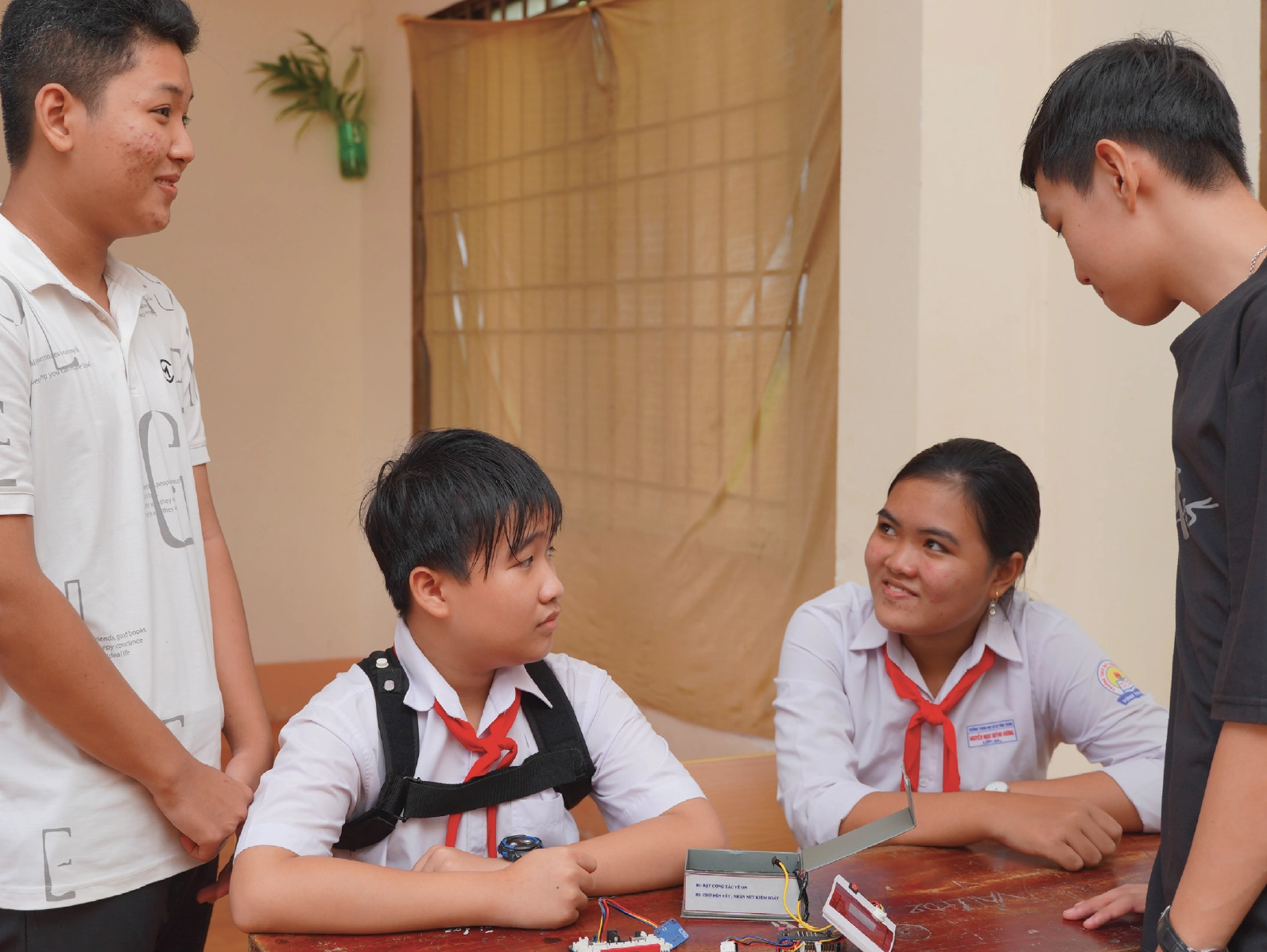
Nowadays, children and young people spend a lot of time on smart devices, leading to severe kyphosis (an exaggerated, forward rounding of the upper back). Our team developed a smart wearable to protect children from kyphosis and school violence, abuse and bullying.
How does it work? Wearing the device, it will send an alarm sound if they are in a setting lacking of light. Or when they bend the back to a certain level, it will also send an alarm.
At the same time, the device works as an SOS button: If a student gets into a dangerous situation, they can press the SOS button abd the speaker will make a loud noise. In case the user cannot press the button, we used a sensor processed by a micro:bit to predict the gestures to identify it as a dangerous situation.
And last but not least, this device also works as a GPS locator so that the parent can manage their children.
“Can you fit an interesting life between two book covers? Yes, but sometimes a lot of exciting things have to be left out. Also because paper can’t reproduce sound or movies.” Swiss journalist Mark van Huisseling came to this conclusion and developed a digital biography of Thomas Trüb, founder and president of The Dariu Foundation, to be viewed on laptop, tablet, smartphone et cetera.
The trilingual website “Life of Thomas” – German, French and English – is now online. In addition to a detailed portrait of Thomas Trüb (headline: “The last yuppie”, published in the NZZ am Sonntag magazine), there are numerous original sounds from “TT” and his companions, plenty of pictures plus music (including a song composed especially for Thomas) and a conversation with ChatGPT about what the entrepreneur Trüb would probably do today.
It has been proven that drones are being used more and more frequently in rescue operations and are becoming increasingly helpful and effective. For example, when a fire breaks out in a residential building located in narrow alleyways in cities. A drone can help transport fire extinguishing balls, masks or other equipment to support rescue operations. During firefighting operations, the drone is also used to identify people in need of help in areas that are difficult to access, rooms or tall residential buildings or in smoky areas.
The camera streams live images to the control screen, allowing the rescue team to create different and effective plans for rescue operations. The drone is designed to carry two fireballs at a time. It uses camera and heat sensors to detect fire, and the user can control the dropping of the fireballs.
The drone can also be used for other rescue missions; for example, to transport water, food, milk or other supplies to assist rescue teams.
The system uses a sensor to measure air quality. Once gas/CO2 is detected, it sends a signal to a relay, to turn on a speaker, which then warns the people in the room with a loud noise.
Between September and October 2023, TDF organized 10 school-based hackathons to train 800 Code Club students in project brainstorming (problem/solution finding) and creative thinking. The top 30 Code Club leaders (53% are girls) received advanced training, including leadership, critical thinking, problem solving, and project management. Each of them was supported and coached by a mentor from the university and a mentor from a relevant/IT company to enhance their strengths, learning potential, and career paths, especially in the technology sector.
Following these training workshops, 70 proposals for technology-based innovative ideas/solutions were submitted to TDF by October 2023. Of the 70 teams, 40 eligible teams (including 25 teams of secondary and high school students and 15 teams of university students) were selected to participate in the incubation boot camp.
The bootcamp is a two-month event where the participants will be teamed up with mentors (from universities and industry) who will guide them through the steps of starting a business, including developing initial ideas, testing hypotheses, customer journey, business model, etc. All teams will receive a small grant to build a prototype of their project that can be tested by customers.
By mid-November, the top 12 teams will be selected to participate in the final round of the business model competition in early December 2023.
See more of the innovative projects the Code Club students develop here: http://dariu-new.drack-design.ch/digital-literacy-en/code-clubs-en/projekte-en/
An intelligent robot designed for use in hospitals and high risk isolation areas.
How does it work?
The robot is equipped with an arm, a storage compartment and a navigation system, and is controlled by WiFi navigation.
When something needs to be transported to a specific area/room, hospital staff place the item on the tray and enter the destination. The robot then travels to the designated location and notifies both the recipient to pick up the items and the sender that the items have been delivered. Along the way, it can also pick up other items, as long as they have the same destination.
The notifications are sent to the users/senders via a Telegram account.
When looking at the container library donated by The Dariu Foundation at his schoolyard, Cuong Tran, 14 years old, told his classmate Phu Nguyen that he wished the container library were movable, so that they could move it from school to school. They decided to develop a movable house as their summer project. Micro:bit is used as the central controlling system to connect and control other external sensors such as lighting, humidity and proximity, and motor servo. A light sensor is used to transfer a signal to the Micro:bit for automatic lighting; a humidity sensor is used for watering, and pumping; a motor servo is utilized for opening/closing the main doors. “Our dream was to make a house that’s able to fly like a drone,” said Cuong Tran.
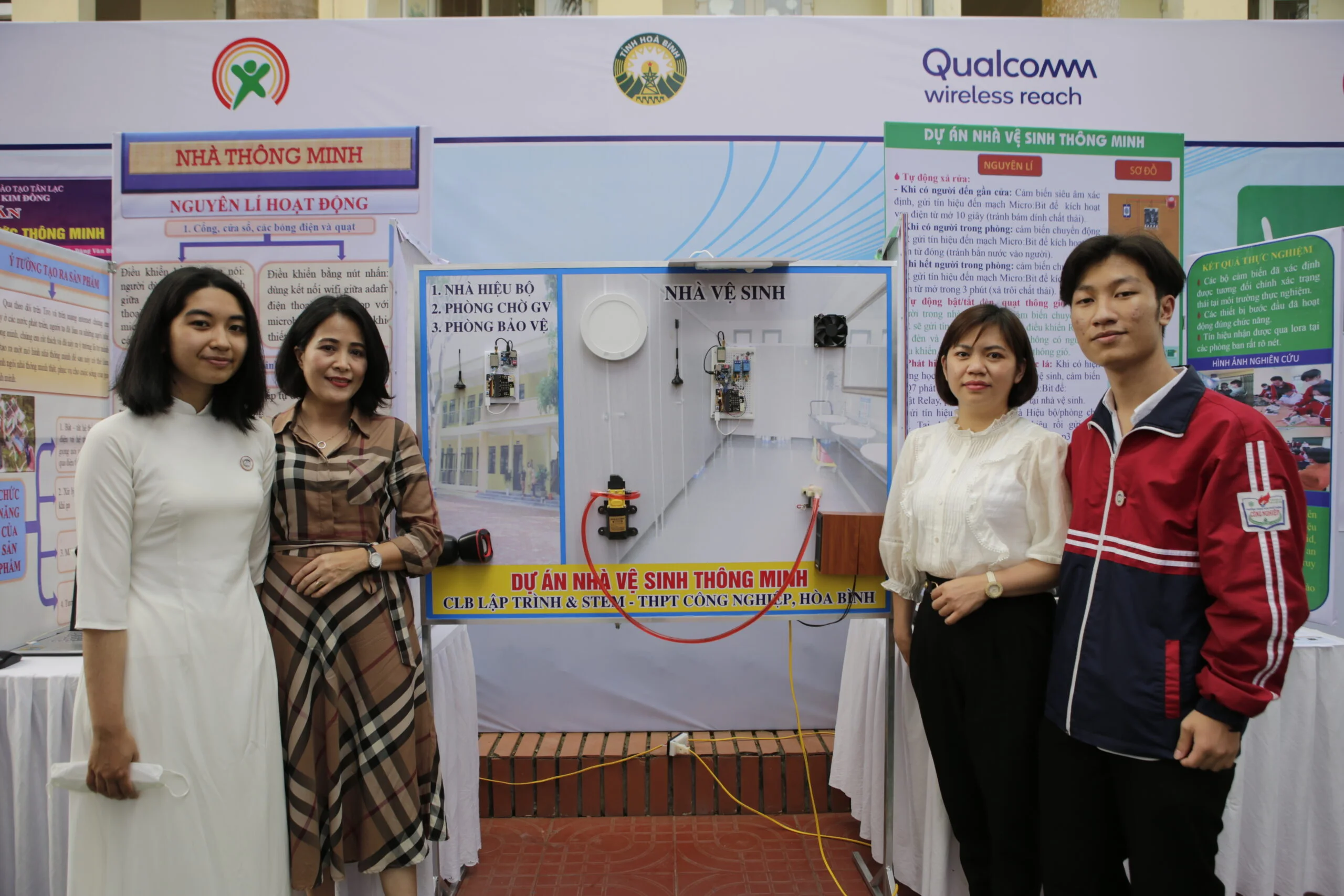
School toilets often has three problems: electricity and water waste and smoke (illegal smoking) by students. Our group developed a Micro:bit-based project to solve these problems.
The system has two functions:
All fans and lamps are connected to motion sensors, and the ventilation and lighting system are only switched on when the users move.
Cigarette smoke sensors are installed in the restrooms, and as soon as smoke is detected, the alarm goes off and sends an alert to the manager at the same time
Future upgrade: Our team would like to upgrade the water supply with hand sensors so that water only flows when users put their hand to the faucet. At the same time, the water runoff from the sink will be used to irrigate the school garden.
All the patient’s information, such as blood pressure, pulse etc. are monitored and appear on the screen, next to the bed. The system sends a warning signal to the attending doctor/staff, if any of these stats are irregular and/or of concern.